SMART HABITAT // EXECUTIVE BIO-ARCHITECTURE
REVISION LOG — 1 ENTRYMOST RECENT: 2026-08-01
- 2026-08-01Deployed full O.B.M. deep-analysis (circadian light / thermal sleep / indoor air) and replaced stale Wix self-references with primary peer-reviewed sources. Truth-first: circadian & air strongly supported; thermal real but individual.
Every entry above was written when the change was made, not reconstructed afterwards. Where we were wrong, the wrong version is named.
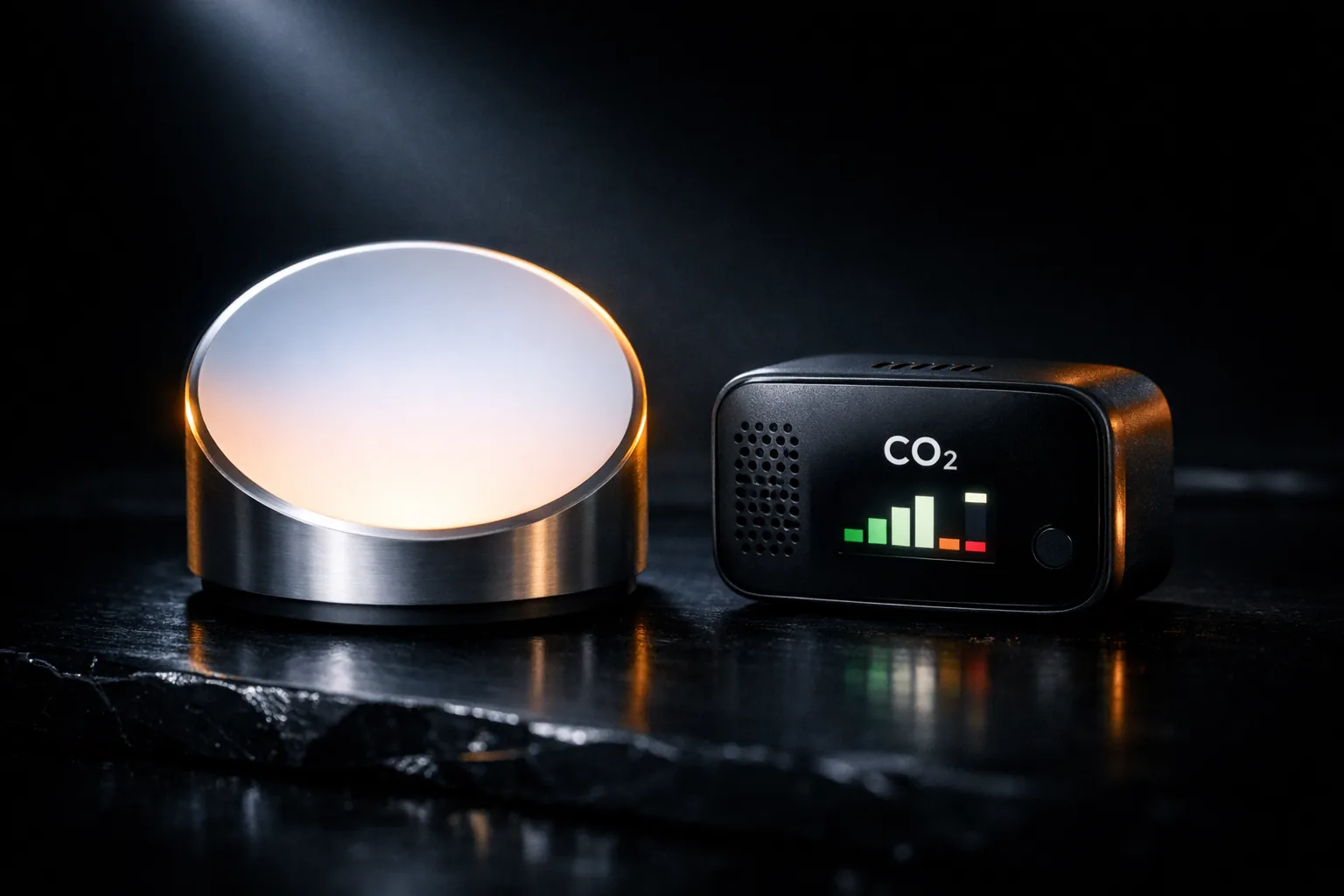
Executive Friction begins at the environmental layer — the gains that accrue while you do nothing. Three sub-systems carry the strongest evidence: circadian lighting (bright, cool morning light and dim, warm evening light entrains the sleep-wake clock); thermal sleep regulation (active cooling shortens sleep onset and supports deep sleep for many); and air quality (elevated indoor CO₂ measurably degrades cognitive-function scores — ventilation and HEPA filtration protect focus).
Executive friction begins at the environmental layer — the habitat works on you while you sleep and think, with zero willpower spent. Three sub-systems carry the evidence: circadian lighting, thermal sleep regulation, and indoor air. Two of them are strongly supported; one is real but individual. Grading them honestly is the difference between engineering and gadget theater.
This is passive infrastructure, not therapy. The devices are levers on well-established physiology — light timing entrains the clock, a falling core temperature gates deep sleep, and clean air protects cognition. None of it treats disease; all of it moves the baseline.
Circadian Lighting — The Clock's Master InputTIER A
Timed morning bright light advances circadian phase and stabilizes the sleep-wake clock — the single strongest lever on when you fall asleep and how alert you are on waking. Low daytime light, by contrast, leaves the system hypersensitive to light at night.
Bright or blue-shifted light in the evening acutely suppresses melatonin and raises alertness — measured melatonin suppression runs as high as ~87% under strong evening light. Dim, warm evening light removes that brake and lets sleep onset arrive on time.
Schedule it: cool/bright light within the first hour awake; warm/dim light after sunset. Tunable lighting automates the clock so you don't have to remember it.
Thermal Sleep — Real, but IndividualTIER B (INDIVIDUAL)
Sleep onset requires the core body temperature to fall by roughly 1–3°F, via heat dissipation through the skin — and a lower core is a prerequisite for the slow-wave activity that defines deep sleep. Reviews place the optimal ambient bedroom range around 15.6–19.4°C for most healthy adults.
How much a cooling surface or cooler room helps varies by age, sex, bedding, sleepwear and acclimatization. Conductive cooling has been shown to raise slow-wave (N3) sleep and lower nocturnal heart rate for many — but 'many' is not 'everyone.' Calibrate against your own recovery data.
Set the room cool and, if you run hot, add an active-cooling surface — then verify with your ring/strap trend, not with the marketing claim. This is the one habitat lever to personalize.
Indoor Air — The Invisible Cognitive TaxTIER A
Controlled chamber work (Allen et al., COGfx, 2016) found cognitive-function scores roughly 15% lower at ~950 ppm and ~50% lower at ~1400 ppm versus a fresh-air baseline — with the steepest decision-making decrements by ~2500 ppm (Satish 2012). A closed office or bedroom crosses 1000 ppm quietly.
Ventilation keeps CO₂ under ~1000 ppm during deep work; HEPA filtration drops particulate load. Both are passive once installed — the cognition is protected without a single act of willpower.
Put a CO₂ monitor where you do your hardest thinking. If it climbs past 1000 ppm, ventilate — you are paying a focus tax you can't feel.
The smart-habitat market sells three upgrades as if they were equally validated. They are not. Grading them apart is the whole point.
Light timing is the most robust environmental lever on the sleep-wake clock — morning light advances phase, evening light suppresses melatonin. Deploy as baseline.
Morning bright light — circadian phase advance (PMC) ↗Elevated CO₂ measurably degrades cognition in controlled studies. Keeping the room under ~1000 ppm is a documented protection of focus.
Allen et al. — COGfx (Environmental Health Perspectives, 2016) ↗The core-temperature mechanism is solid; the magnitude of benefit from a given device varies person to person. Verify against your own recovery data rather than the brand's average.
Thermoregulation & sleep — comprehensive review (J. Clin. Med., 2026) ↗The habitat is the highest-leverage passive infrastructure on the grid — but not uniformly proven. Circadian light and indoor air are strongly evidenced and should be deployed as baseline; thermal cooling rests on a solid mechanism with an individual response and should be personalized against your own telemetry. OCCABUZZ grades the layer, not the label: install the two that are proven, calibrate the one that is personal, and treat any device that promises therapy as an optimization tool overreaching.
The habitat does the work while you sleep and think — but only two of its three headline upgrades are strongly proven. Install circadian lighting (cool mornings, warm nights) and clean, sub-1000-ppm air as non-negotiable baseline infrastructure; add thermal cooling and verify its benefit against your own ring or strap trend rather than the marketing average. OCCABUZZ grades the layer, not the label: deploy what's proven, personalize what's individual, and never mistake an optimization device for therapy.
- ›Tunable circadian lighting (e.g., Philips Hue) — schedule cool mornings, warm nights.
- ›Active-cooling sleep surface (e.g., Eight Sleep Pod) — temperature-regulated deep sleep.
- ›CO₂ monitor + HEPA purifier — keep the room under 1000 ppm during deep work.
The habitat does the work while you sleep and think. Correct light timing repairs sleep onset; sub-1000 ppm air preserves afternoon cognition; a cool bed buys deep-sleep minutes — all passively, every night.
Circadian and air-quality effects are well-supported; thermal response is individual. Devices are optimization tools, not therapy.
Peer-reviewed trials — sample size, effect size, stage.
Applies to healthy apex, not only to clinical deficit.
Survives a demanding calendar. Zero executive friction.
Deployable with named caveats. Context-dependent.
The score is a geometric mean — a single failed layer collapses it. Excellence in two cannot rescue a gap in the third. That is why hype scores low and proven, feasible, broadly-applicable work scores high. The restraint is the product.