THE TELEMETRY LOOP // CONTINUOUS GLUCOSE MONITORING

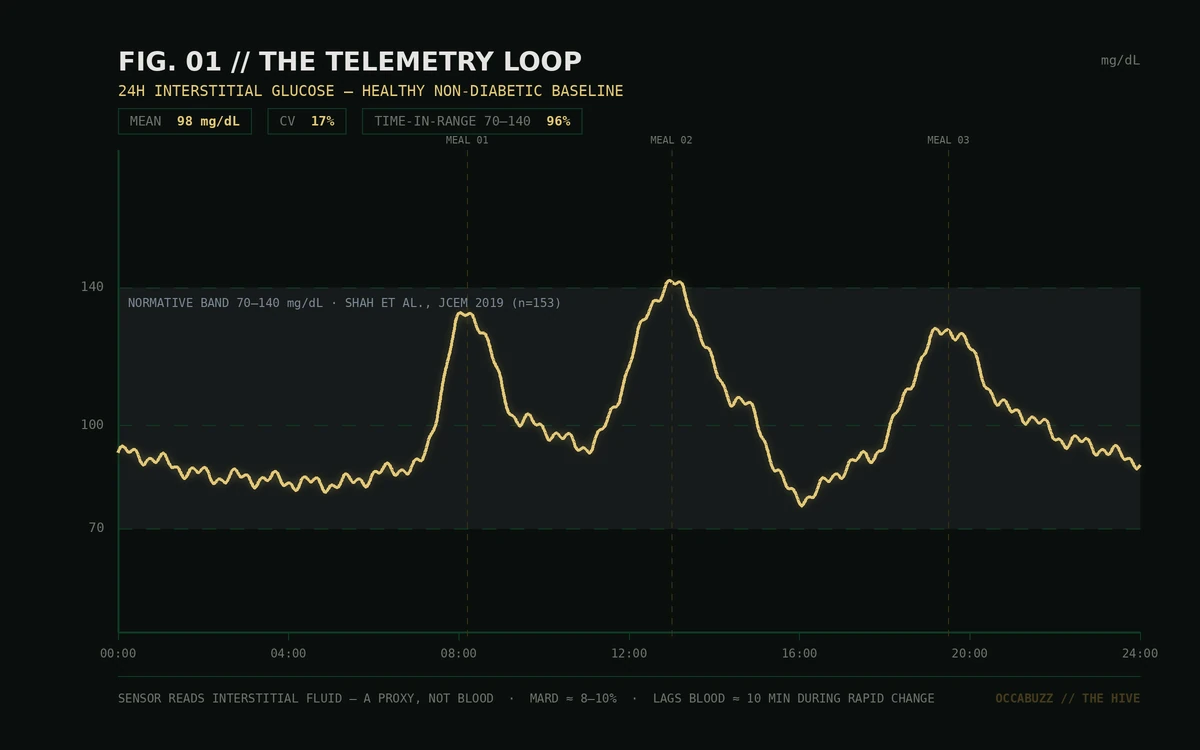
A continuous glucose monitor is the first consumer device that makes an invisible process — your body's minute-to-minute response to food, stress, and sleep — visible in real time, and it is now sold over the counter to people with no diabetes at all. On a healthy operator its proven value is narrow and real: it is a behavioral instrument. It shows which of your specific meals and habits move your glucose, and lets you rewrite the ones that sabotage the next two hours. The science underneath is genuinely strong — the same meal provably spikes different people differently, so population diet advice is a blunt tool for any single body (Zeevi et al., Cell 2015). What the device lacks is the thing the wellness market implies it has: any trial showing that flattening an already-normal curve extends healthspan in someone who isn't diabetic. A 2024 review in Diabetic Medicine judged that evidence thin enough to call the commercial claims 'misleading.' The sensor is validated. The longevity promise stapled to it is not.

The continuous glucose monitor is the rare wellness device whose hardware actually earns its keep. It takes a process that was invisible for all of human history — your body's minute-to-minute response to a meal, a bad night, a stressful call — and puts it on a screen in real time. For a metabolically healthy operator that is worth something concrete. It is also worth considerably less than what the market staples to it.
Start with what the sensor measures well: the shape of your day. Normative data from 153 healthy, non-diabetic people put mean glucose at 98–99 mg/dL, time between 70–140 mg/dL at 96%, and within-person coefficient of variation at 17% (Shah et al., JCEM 2019). That is the reference frame. Every excursion the device shows you is read against it — and against it, most of what a healthy person sees is a normal curve doing normal things.
The gap opens at the other end of the claim. No trial has shown that flattening an already-normal glucose curve extends healthspan in a person who is not diabetic. A 2024 narrative review in Diabetic Medicine went further than 'unproven' — it judged the evidence base for CGM in people not living with diabetes thin enough to call the commercial claims 'misleading' (Oganesova et al.). This dossier holds both truths without blinking. The loop is a real behavioral instrument. The longevity story sold on top of it has not been written.
The Personalization EngineTIER A (INDIVIDUAL VARIABILITY) / TIER B (BEHAVIOR CHANGE)
The foundational finding is that the same meal moves different people differently — reproducibly. Zeevi and colleagues tracked 800 people across 46,898 meals and found postprandial responses to identical food varied enough that population-level dietary rules have limited predictive power for any single body. Their machine-learning model — built on blood markers, habits, anthropometrics, and gut microbiome — predicted personal responses far better than carbohydrate counting, and a blinded RCT using it flattened postprandial glucose (Cell 2015). An independent 327-person US cohort of non-diabetic adults replicated it: the personalized model reached R=0.62 against 0.40 for carbohydrate content and 0.34 for calories (Mendes-Soares et al., JAMA Network Open 2019).
This is the loop's real edge, and it is not a number to chase. It is a map of which specific foods, orderings, and timings spike you — the rice that wrecks your afternoon, the breakfast that holds you flat, the walk that blunts a dinner. Run for two-to-four weeks as a diagnostic rather than worn as a permanent tether, the CGM converts generic nutrition advice into a personal ruleset built from your own data. That is a use the evidence supports.
The Feedback Effect & The CeilingTIER B (BEHAVIOR) / TIER C (HARD OUTCOMES, HEALTHY)
Pooled across 25 randomized trials and 2,996 participants, CGM-based feedback lowered HbA1c by 0.28% and raised time-in-range by 7.4% versus arms without it — with non-significant effects on body weight and BMI (Richardson et al., Int J Behavioral Nutrition & Physical Activity 2024). Two caveats decide how much that number is worth to us. Most of the evidence sits in type-2 diabetes, not healthy users. And the reviewers flagged that 44% of the trials carried CGM-industry conflicts of interest. A real effect, a small one, largely measured in the wrong population for our purposes.
Does dampening already-normal variability extend a healthy life? No trial answers yes. A meta-analysis of 71 studies found glycemic variability is elevated in prediabetes and tracks beta-cell function — but is not cleanly associated with obesity, insulin sensitivity, lipids, or blood pressure in people without diabetes, and most of the outcome data are cross-sectional (Hjort et al., Clinical Nutrition 2024). Variability may one day earn its place as an early risk flag. It has not been shown that a healthy operator chasing a flatter line changes where they end up. That sentence is the exact border between EMERGING and CLINICAL.
The device reads interstitial fluid, not blood. It runs roughly 8–10% off a lab value on average and lags blood by about ten minutes when glucose is moving fast — right after a meal, during exercise (mechanism documented in Zaharieva et al., Diabetes Technology & Therapeutics 2019). Read trends, not decimals; a single alarming post-meal number is usually the sensor catching up. One further risk deserves naming plainly: in some users, watching every excursion breeds anxiety and restrictive eating. The loop is meant to inform behavior. The moment the number starts running the operator, it has inverted.
Is a CGM on a healthy operator a precision longevity instrument — or a validated sensor wrapped in an unproven promise?
A genuine measurement tool. It captures your personal glucose shape with useful fidelity and exposes short-term variability that no fingerstick or HbA1c can see. The hardware is not the weak link.
Shah et al. — Normative CGM profiles in healthy non-diabetics (JCEM, 2019) ↗Personalized response mapping is among the best-replicated findings in nutrition, and CGM feedback moves glycemic metrics a small, real amount. The edge is diagnostic — a personal spike-map — not a metabolic rewrite.
Zeevi et al. — Personalized Nutrition by Prediction of Glycemic Responses (Cell, 2015) ↗No trial shows that flattening normal curves extends healthspan in non-diabetics. A 2024 review judged the wellness-market evidence thin enough to call its claims 'misleading.' This is the part being sold hardest and supported least.
Oganesova et al. — CGM in people not living with diabetes: a narrative review (Diabetic Medicine, 2024) ↗The honest synthesis: the CGM is the wellness device whose hardware actually works — it measures something real, and the personalization science beneath it is among the strongest in the field. What has not been earned is the leap from 'I can see my glucose' to 'flattening it will make me live longer.' For a healthy operator the calibrated deployment is a two-to-four-week diagnostic: extract your personal spike-map, build the rules, take the sensor off. Worn as a permanent longevity tether, it is a subscription paid against a promise no trial has kept. A validated sensor. An unwritten outcome.
Before subscribing to a permanent glucose feed, notice that the free version of this signal already exists. Fiber and protein before the starch flattens a meal. A ten-minute walk after eating blunts the spike. Protecting sleep tightens glucose control the next day, and not stacking your largest carb load at night — when you are most insulin-resistant — removes the worst excursion on most people's trace. These are the behaviors a CGM would steer a healthy operator toward anyway. The sensor's real gift is personalization and motivation: seeing your own spike makes the change stick in a way a printed guideline never will. Use the loop to find your rules, then live by them without the patch. It is a teacher, not a life-support line.
OCCABUZZ sells no device and earns no commission on any CGM — our revenue comes only from the operators we serve, never from what we grade, and it changes nothing about this grade. We publish the sensor as validated, the behavioral signal as modest, and the longevity claim as unproven, in that order, because the market sells them in reverse. Forty-four percent of the trials in this field carry industry conflicts of interest; we carry none. The data drives the grade. Nothing else does.
Peer-reviewed trials — sample size, effect size, stage.
Applies to healthy apex, not only to clinical deficit.
Survives a demanding calendar. Zero executive friction.
Deployable with named caveats. Context-dependent.
The score is a geometric mean — a single failed layer collapses it. Excellence in two cannot rescue a gap in the third. That is why hype scores low and proven, feasible, broadly-applicable work scores high. The restraint is the product.