Flatten the curve on levers that already carry human proof · the behavioral route
WEARABLE // TELEMETRY
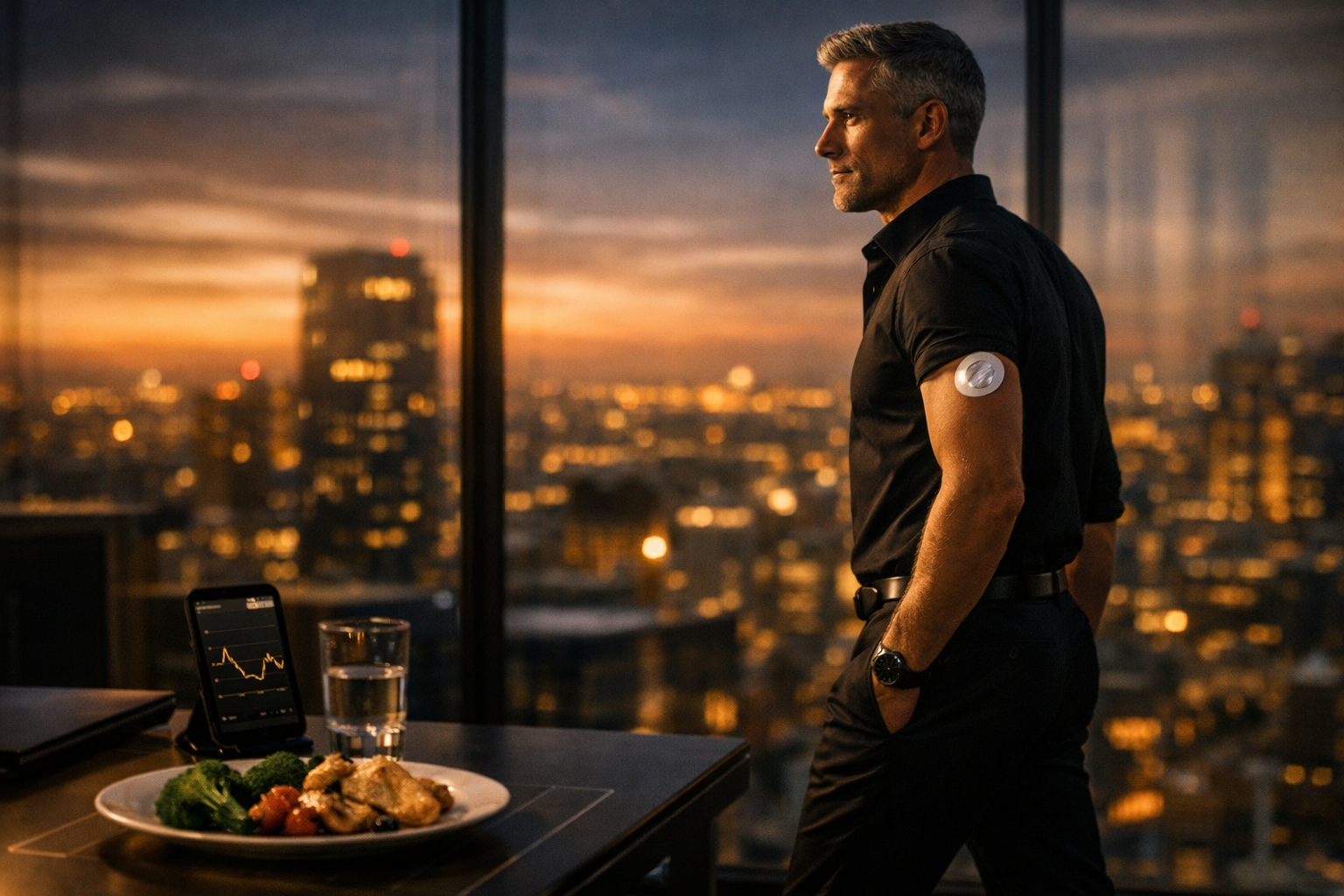
◇ THE OPERATOR — GLYCEMIC CONTROL DEPLOYED: THE MEAL RE-ORDERED, THE POST-MEAL WALK, THE SENSOR AS A TEACHER.
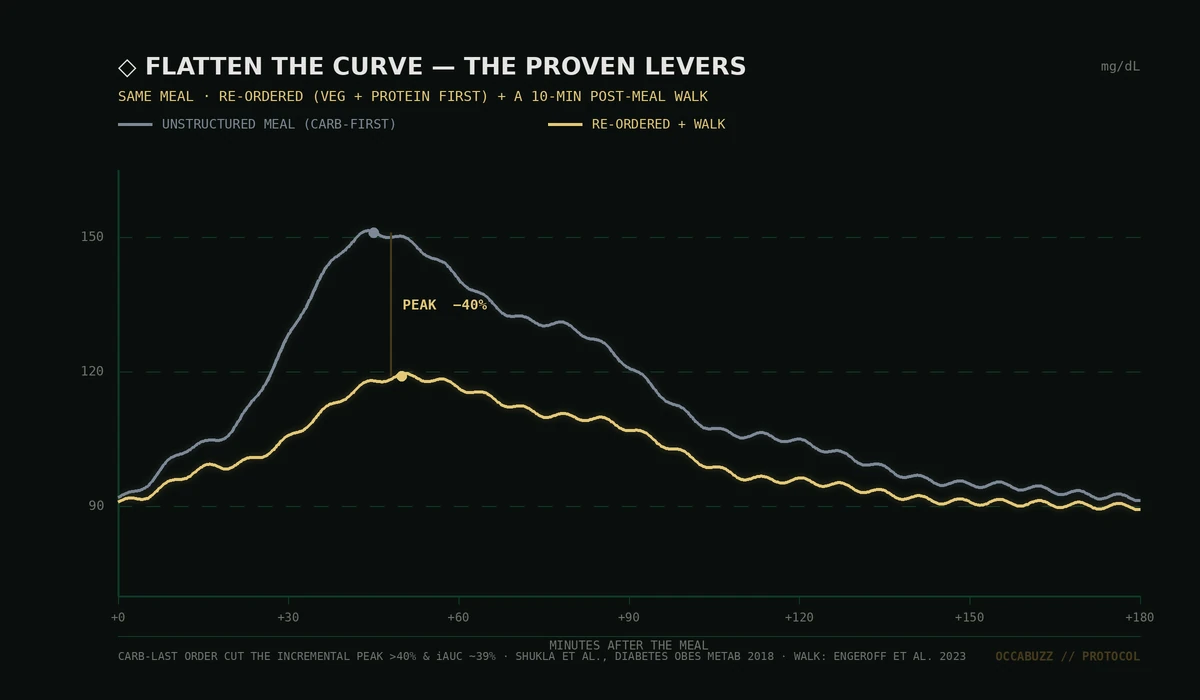
◇ FLATTEN THE CURVE — THE SAME MEAL, RE-ORDERED AND WALKED OFF, CUTS THE PEAK >40% (SHUKLA ET AL. 2018)
◇ WHAT IT IS
Dossier 003 covered the continuous glucose monitor — a validated sensor whose real value in a healthy operator is behavioral, wrapped in a longevity promise no trial has kept. This protocol is what the sensor teaches once you take it off: the handful of behaviors that flatten a glucose curve and that already carry controlled human evidence — no subscription, no patch, no waiting on outcome data that doesn't exist yet.
The premise is plain. A CGM's best trick is showing you which meals spike you and rewarding you for the fix. But the fixes themselves are known, and they are the same for almost everyone: order the plate so starch comes last, walk for ten minutes after eating, protect sleep, and stop stacking your biggest carb load at night. Run a sensor for a few weeks to personalize the details if you like — then live on these, which are the rules it was always going to hand you.
◇ THE COMPONENTS
Food Order — starch lastEating vegetables and protein before concentrated carbohydrate cut the incremental glucose peak by more than 40% and the area-under-the-curve by ~39% versus the same meal carb-first, in a controlled human study — a free change to the sequence, not the food.
The Post-Meal Walk — ten minutes, soonLight activity in the half-hour after eating lowers the postprandial glucose excursion; a meta-analysis found exercise after the meal beats the same exercise before it, and sooner beats later. A short walk is the highest-yield ten minutes in the day.
Sleep — the insulin-sensitivity leverOne week at five hours a night cut insulin sensitivity ~20% in healthy men; a 41-trial meta-analysis confirms sleep restriction degrades insulin sensitivity. The flattest curve is built the night before, not at the table.
Carb Timing — not at your worst hourInsulin resistance runs higher at night for most people. Shifting the largest carbohydrate load earlier removes the single worst excursion on a typical trace — a placement change, not a restriction.
Personalization (optional) — the sensor as a teacherThe same meal moves different people differently (Zeevi et al.), so a 2–4 week CGM diagnostic can reveal your specific offenders. Use it to tune these levers, then retire it — see Dossier 003.
◇ HOW TO DEPLOY — DAILY TIMING
Every mealVegetables/protein first, concentrated carbohydrate last — reorder the plate, keep the foodSequence
Within ~30 min of eatingA 10–15 min walk — the postprandial excursion drops most when the walk comes soon after the mealMovement
Nightly7–9 h sleep — the insulin-sensitivity foundation the daytime levers depend onRecovery
Daily patternFront-load carbohydrate earlier in the day; keep the late-night meal lighter on starchTiming
Optional · 2–4 weeksWear an OTC CGM as a diagnostic to personalize the above, then take it off — read trends, not decimalsTelemetry
◇ WHAT CHANGES IN YOUR DAY
The win is immediate and free: fewer post-meal crashes, a steadier afternoon, and a flatter curve reached by resequencing and walking rather than by buying a data feed. These are the exact behaviors a CGM would nudge a healthy operator toward — available today, with human trials behind them, at zero cost.
The long game is metabolic durability without dependence. A body that eats in the right order, moves after meals, and sleeps enough holds insulin sensitivity across decades — the outcome the wellness market implies a sensor delivers, built instead from habits that a subscription can only point at.
2035 HORIZONPROJECTION · NOT PROVEN FACT
The sensor, graded honestly
As OTC glucose sensors get cheaper and pair with AI coaching, they will be sold ever harder as longevity infrastructure. When trials finally test whether flattening normal curves extends a healthy life, OCCABUZZ will grade the verdict against this free baseline — because a device that merely nudges you toward eating order, a walk, and sleep is a teacher worth renting briefly, not a life-support line worth wearing forever.
Metabolic telemetry, matured
The near-term operator will fuse glucose with sleep, HRV, and activity into a single metabolic picture — using it to confirm the levers are working, then trusting the habit over the readout. The endpoint of good telemetry is not more monitoring. It is a body you no longer have to monitor.
⧗ OPERATOR ADVISORY
Not medical advice. Food order, post-meal walking, sleep, and carbohydrate timing are low-risk for most healthy adults; clear new exercise or major dietary change with a clinician if you have a medical condition, are pregnant, or take glucose-lowering medication. A continuous glucose monitor is a wellness diagnostic here, not a diagnostic test — an abnormal pattern is a reason to see a physician, not to self-diagnose. See Dossier 003.
◇ THE STANDARD // APPLIED TO THIS ASSET
◇ THE AUDIT — THIS ASSET, ON THE STANDARDCALIBRATED CERTAINTY = ∛(E · C · I)
Applies to healthy apex, not only to clinical deficit.
03 IMPLEMENTATION74
Survives a demanding calendar. Zero executive friction.
CONDITIONAL
Deployable with named caveats. Context-dependent.
The sliders start at the OCCABUZZ assessment for this asset. Drag any layer to test the standard against our call.
The score is a geometric mean — a single failed layer collapses it. Excellence in two cannot rescue a gap in the third. That is why hype scores low and proven, feasible, broadly-applicable work scores high. The restraint is the product.