PASSIVE BIOMETRIC INTELLIGENCE // THE RING STANDARD
REVISION LOG — 3 ENTRIESMOST RECENT: 2026-08-01
- 2026-08-01Deployed full O.B.M. deep-analysis: OSSA 2.0 PSG validation (96 participants / 421,045 epochs), ECG-grade nocturnal HRV/RHR (r²≈0.996/0.980), and the TemPredict/Smarr early-illness thermal signal — graded truth-first (trends over absolutes; wake & deep-sleep the soft metrics; temperature a flag, not a diagnosis).
- 2026-07-03Added OSSA 2.0 accuracy-profile radar (96-participant PSG validation).
- 2026-05-22Initial dossier issued at CONSUMER-VALIDATED grade.
Every entry above was written when the change was made, not reconstructed afterwards. Where we were wrong, the wrong version is named.
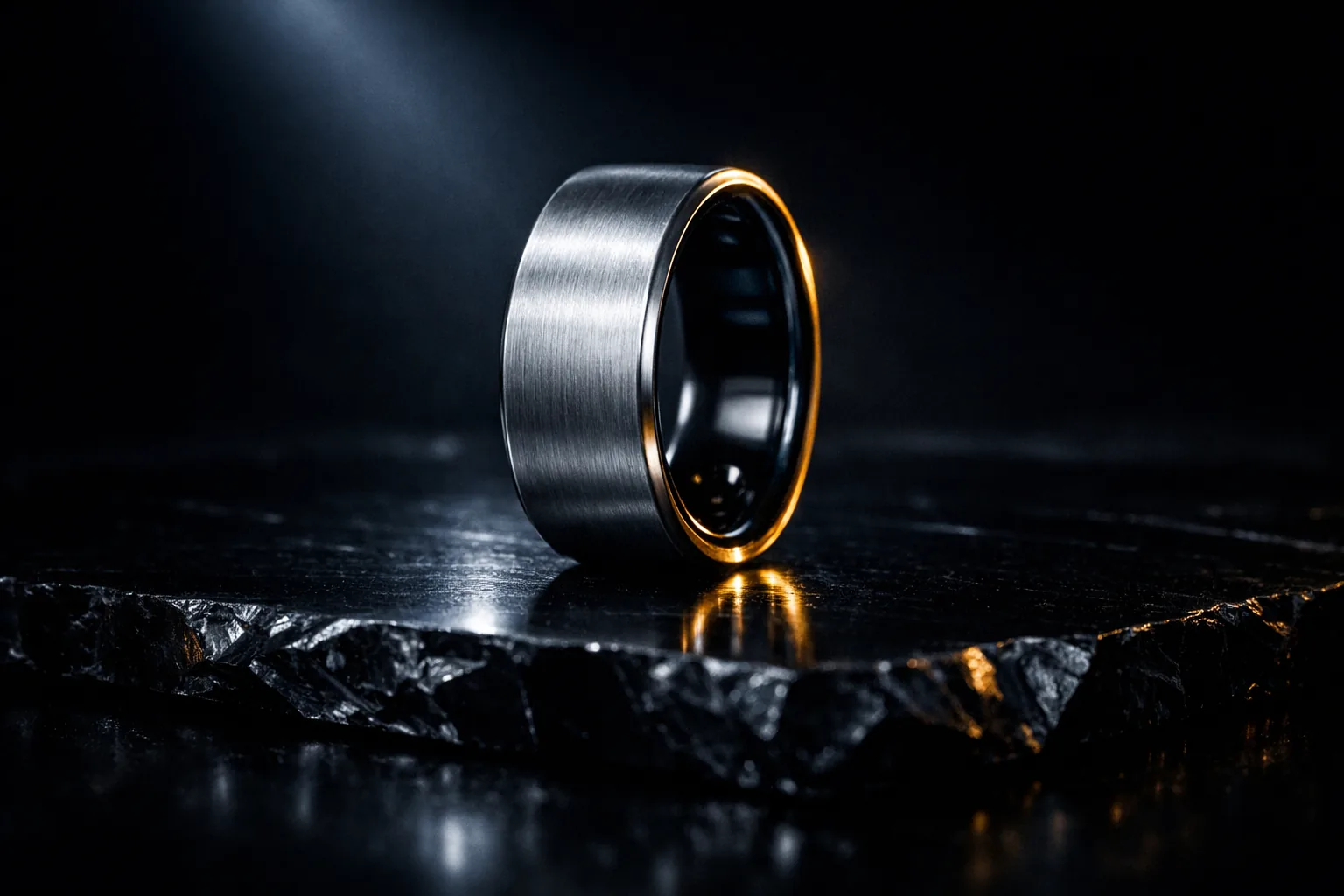
The most defensible wearable vector is the finger, not the wrist. Oura Ring 4 runs an 18-path multi-wavelength PPG array with 'Smart Sensing' that dynamically reconfigures optical paths — yielding a reported 120% improvement in SpO₂ signal quality, 31% in nighttime heart rate, and 7% in daytime heart rate versus the prior generation. Its sleep-staging algorithm is validated against polysomnography, the clinical gold standard. This is passive intelligence: zero executive friction, continuous readiness/HRV/temperature telemetry.
Passive telemetry earns its authority two ways: the signal must be accurate against a clinical reference, and it must be read as a trajectory, not a verdict. Oura clears the first bar cleanly for the signals that matter at night — heart rate, HRV, temperature — and clears it partially for sleep staging. It does not clear it for absolute, single-night precision. Conflating 'validated' with 'clinical diagnosis' is the category error of the entire wearable space.
The finger beats the wrist for one physical reason: at rest the digital artery sits close to the surface with less motion artifact, which is why ring PPG posts the strongest nocturnal cardiovascular agreement of the consumer field. This is a measurement tool for recovery decisions — not a monitor for disease.
Sleep Architecture — Best Consumer, Not PSGCONSUMER-VALIDATED / TIER B
Oura Sleep Staging Algorithm 2.0 (OSSA 2.0) was tested against multi-night ambulatory polysomnography in 96 participants across 421,045 epochs (Sleep Medicine, 2024): sleep/wake accuracy ~91.8%, sensitivity to sleep 94.4%, REM staging 90.6%, and good agreement for time in light and deep sleep. Four-stage agreement reaches ~79% — the best of the consumer sleep trackers independently tested.
Specificity to wake is ~74% — like all PPG-plus-actigraphy devices, it over-calls sleep when you lie still but awake. Deep-stage classification is the softest metric (deep sensitivity ~64%). Single-night absolute minutes drift by fit and finger; the real information is the multi-night trend, not last night's exact deep-sleep figure.
Read the trajectory. Use the multi-day sleep and readiness trend to time cognitive load — do not litigate one night's deep-sleep minutes as if it were a lab report.
Cardiovascular Telemetry — Near-Clinical at RestTIER A (NOCTURNAL)
Validated against ECG, ring PPG posts near-perfect nocturnal resting heart rate (r² ≈ 0.996) and excellent HRV (r² ≈ 0.980) in a 49-adult study (2020); independent cross-device analysis ranks the ring strongest for HRV and RHR against wrist straps (WHOOP, Garmin, Polar). At night, at rest, this is effectively research-grade recovery telemetry.
That accuracy is a nocturnal, at-rest claim. Motion degrades PPG — daytime continuous heart rate from any ring or watch is less reliable than a chest strap. Do not use it for interval-training precision.
Trust the morning HRV/RHR trend as your autonomic dashboard. For live training intensity, deploy a chest strap — right tool, right signal.
Thermal Deviation — The Early-Illness FlagTIER B (POPULATION-SCALE)
Continuous distal skin-temperature tracks illness onset. Smarr et al. found fever onset reflected as roughly +0.63°C, with 93% of cases showing a fever-like abnormality within seven days before symptoms. TemPredict — over 63,000 participants — flagged COVID-associated physiological changes up to ~2.75 days before diagnosis.
Not a thermometer, not a diagnosis. It is a personal-baseline deviation signal — powerful as an early 'something is off' flag, useless as a clinical reading. The value is the deviation from your own norm, not the absolute number.
Treat a temperature-deviation + HRV-drop cluster as a pre-symptom recovery order — defer load, protect sleep — not as a medical event to self-diagnose.
The ring is the highest-signal wearable on the grid — but 'high signal' is not 'clinical-grade' across the board. The honest answer is per-metric.
Against ECG, nocturnal resting HR (r² ≈ 0.996) and HRV (r² ≈ 0.980) are the strongest claim the device makes. At night and at rest, the ring is effectively research-grade.
Oura HR/HRV vs ECG — comprehensive analysis (PMC) ↗~79% four-stage agreement leads the consumer field, but wake detection (~74% specificity) and deep-stage sensitivity (~64%) are the soft spots. Trend-grade, not lab-grade.
OSSA 2.0 vs PSG — 96 participants / 421,045 epochs (Sleep Medicine, 2024) ↗A real pre-symptom signal at population scale (TemPredict, Smarr) — but individual precision varies and it is never diagnostic. An alarm, not a verdict.
Oura — science & research (TemPredict, fever monitoring) ↗The ring is the lowest-friction, highest-signal telemetry on the grid — near-clinical for nocturnal cardio, best-in-class for consumer sleep, a genuine early-illness flag for temperature — provided every number is read as a personal-baseline trend, not an absolute verdict. OCCABUZZ grades it CONSUMER-VALIDATED: trust the trajectory, not the single reading, and never the marketing that calls it a diagnosis.
The finger is the most defensible wearable vector because, at night and at rest, its cardiovascular signal approaches the ECG and its sleep and temperature trends carry real information — provided the operator reads trajectories, not absolutes. Deploy the ring as a passive readiness dashboard that front-runs the first decision of the day: low readiness → defer the high-stakes cognitive load. The moment a vendor calls a consumer ring 'clinical' or 'diagnostic,' that is the marketing outrunning the evidence — and OCCABUZZ grades the trend, not the promise.
- ›Oura Ring 4 — nightly readiness, HRV, resting HR, skin-temperature deviation, sleep architecture.
- ›Use trends, not single readings — the signal is in the multi-day trajectory.
- ›Pair temperature-deviation alerts with early-illness and recovery decisions.
Converts recovery from guesswork into a number you see before your first decision of the day. Low readiness → defer the high-stakes cognitive load. This is the cheapest, lowest-friction upgrade on the grid.
Consumer-grade, not a medical device. Absolute values drift by finger, fit and skin; act on trends. Not for diagnosis.
Peer-reviewed trials — sample size, effect size, stage.
Applies to healthy apex, not only to clinical deficit.
Survives a demanding calendar. Zero executive friction.
Cleared all three layers. Protocol-grade.
The score is a geometric mean — a single failed layer collapses it. Excellence in two cannot rescue a gap in the third. That is why hype scores low and proven, feasible, broadly-applicable work scores high. The restraint is the product.