THE ATTENTION MIRROR // CONSUMER EEG NEUROFEEDBACK
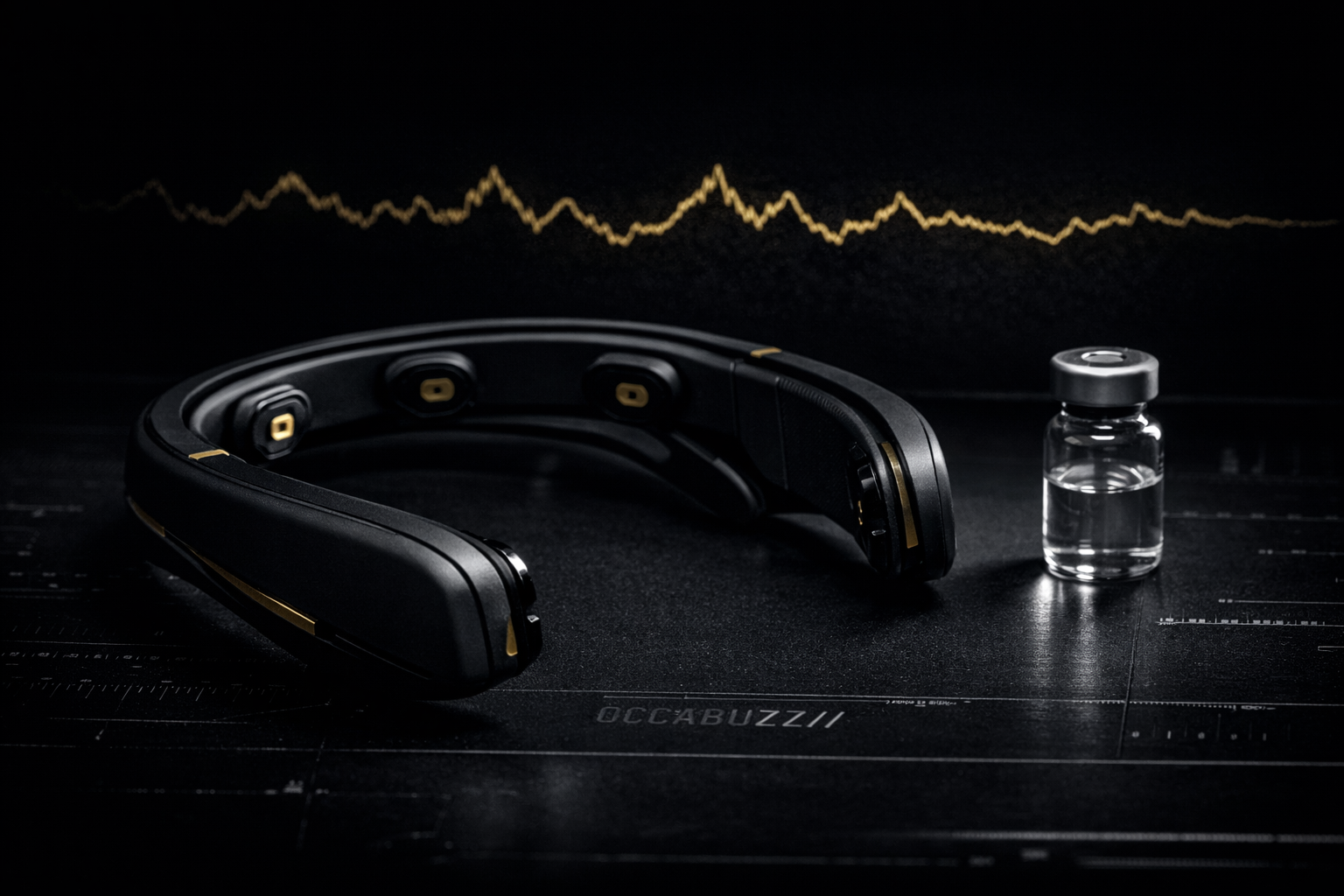
REVISION LOG — 4 ENTRIESMOST RECENT: 2026-10-21
- 2026-10-21Wording: the independence line now reads 'OCCABUZZ sells no products and earns no commission, sponsorship or affiliate fee on anything it names. Its only product will be the Operator Dossier: a subscription for access to your personalized dossiers and the re-audited protocols.' No finding changed.
- 2026-10-16Dossier 033 (meditation and cognition) was published; this dossier now links to it for the evidence on the practice itself.
- 2026-10-15CORRECTION — re-audit. This dossier was audited again from the primary sources. The 2025 meta-analysis was dated 2024. We wrote that no brain-target modulation was found across 16 trials; only 3 reported brain-target scores. We called the in-the-moment benefit proven; it rests on one crossover study partly funded by the headband's maker, which we had not disclosed, and the pooled within-person result was not significant. We said the band makes meditation stickier; we had no source. We wrote that the brain-training claim does not survive a placebo control; none of the trials in the 2025 meta-analysis used sham feedback. We applied an ADHD result in children to meditation headbands; the ADHD meta-analysis is now Westwood 2025 and is reported as ADHD only. We presented a meditation-program effect as an effect of focused-attention meditation and of practice hours; that evidence is being re-audited separately, with the companion protocol. We recommended a 2–4 week onramp; we had no source. The chart used numbers no source reports, and the figure said "across 16 RCTs" and "trait mindfulness" for pooled results; both were removed. The distress result is now stated against what it was measured against: mostly meditation apps. We said cognition showed no effect; it was significant only without correction for reporting bias. A pass on 2026-09-16 had recorded this dossier as holding; it missed these errors. Certainty 53 → 51.
- 2026-07-15Graduated from pipeline monitoring to a gold-standard dossier: Treves-2024 meta (distress g=−0.16, no brain modulation), the Muse score-validity caution (Acabchuk 2020), the focused-attention adjunct signal (Hunkin 2020), the sham-control collapse (Cortese 2016), device-fidelity data (Mikhaylov 2024; Lee 2026), and the proven meditation route (Yakobi 2021). Effect-by-outcome figure, evidence-vs-marketing chart, O.B.M. deep-analysis, 7 refs. Graded EMERGING — real sensor, small adjunct benefit, brain-training likely placebo.
Every entry above was written when the change was made, not reconstructed afterwards. Where we were wrong, the wrong version is named.
A consumer EEG headband reads the brain's electrical rhythms through dry electrodes and turns them into a calm-or-distracted score while you meditate. The sensor is real: consumer bands detected the alpha rhythm against a research system (Lee 2026). What it is sold as is a brain trainer. Across 16 randomized trials of consumer neurofeedback during meditation, the one effect that stayed significant after correction for reporting bias was a small reduction in psychological distress (g=−0.16), against control conditions that were mostly meditation apps; cognition did not hold up after that correction, mindfulness and physiological health showed no significant improvement, and none of the trials used sham feedback (Treves 2025). That the band trains the brain has not been demonstrated.
A consumer EEG headband reads the brain's electrical rhythms through dry electrodes and turns them into a calm-or-distracted score while you meditate. It is a real sensor. What it is sold as is a brain trainer, and the gap between those two claims is this dossier.
A 2025 meta-analysis pooled 16 randomized trials of consumer neurofeedback during mindfulness meditation, 11 of them with the Muse device. The one outcome that stayed significant after correction for reporting bias was a small reduction in psychological distress (g=−0.16 with the strictest correction), against control conditions that were mostly meditation apps. Cognition was significant only without that correction (g=0.31; g=0.07 with it); mindfulness and physiological health showed no significant improvement. None of the trials used sham feedback, and the authors raise neurosuggestion — the placebo of neurotechnology — as a possible driver (Treves 2025).
We grade it EMERGING: the sensor is real and the distress effect is small. The brain-training claim has not been demonstrated.
The Sensor — Real, But RoughTIER B
In 30 people, four consumer headbands — the Muse 2 among them — detected the alpha rhythm when tested against a research-grade system with structured protocols; the Muse 2 lost the most recordings to noise (Lee 2026). The signal is real.
Against a laboratory amplifier, all three consumer devices tested showed higher power in the low-frequency bands, typical of dry electrodes, and the Muse S had the poorest signal quality (Mikhaylov 2024). The calm score on your phone is a proprietary number built from that signal.
The Effect — Small, Mostly Against AppsTIER B / C
Across 11 randomized trials, neurofeedback during meditation reduced psychological distress slightly more than the control conditions (g=−0.16), and the controls were mostly meditation apps; the authors suggest meditating with the device may bring more motivation, self-efficacy and expectation of benefit (Treves 2025). Results were similar when only active controls were counted (Treves 2025). In a newer randomized trial of 137 undergraduates over 8 weeks, meditation with consumer neurofeedback, guided meditation and a passive control did not differ in mindfulness or perceived stress, measured after the intervention only (Jahani 2026).
In one crossover study of 68 adults meditating with and without the band's audio feedback, feedback was associated with higher state mindfulness (RR 1.15) and less device-measured mind-wandering (Hunkin 2020). The study was partly funded by the headband's maker, which also supplied the bands. Pooled across within-person studies, the difference in state mindfulness was not significant (Treves 2025).
Not demonstrated. Only 3 of the 16 trials reported brain-target scores, and an exploratory analysis found no effect; within-person studies found no difference either (Treves 2025). Cognition improved only before correction for reporting bias (Treves 2025). In a randomized trial of 53 beginning meditators, the Muse calm score did not track measured mindfulness (Acabchuk 2020).
None of the trials in the 2025 meta-analysis used sham feedback, the test that separates the feedback from the expectation (Treves 2025). In a different use — neurofeedback for ADHD — a meta-analysis of 38 randomized trials found no significant improvement in symptoms rated by probably blinded assessors (Westwood 2025); that result is about ADHD, not about meditation headbands.
Is a consumer EEG headband a brain trainer, or a real sensor with a small, possibly expectation-driven effect?
Detected the alpha rhythm in one validation, with the Muse 2 losing the most recordings to noise (Lee 2026); the Muse had the poorest signal quality of three in another (Mikhaylov 2024).
Lee et al. — evaluation framework for consumer-grade EEG devices (Sci Rep, 2026) ↗g=−0.16 across 11 trials, against mostly app-based controls, with no sham control in any of them (Treves 2025).
Treves et al. — consumer-grade neurofeedback with mindfulness meditation: meta-analysis (J Med Internet Res, 2025) ↗No brain-target effect in the 3 trials that measured it, no cognitive gain that survived correction for reporting bias, and a calm score that did not track mindfulness (Treves 2025; Acabchuk 2020).
Acabchuk et al. — measuring meditation progress with a consumer-grade EEG device (Mindfulness, 2020) ↗The headband is a real sensor with a small effect on distress, measured mostly against meditation apps and, in the pooled trials, never against sham feedback. That it trains or upgrades the brain has not been demonstrated.
The band reads a real signal and, against mostly meditation-app controls, came with a small drop in distress (Treves 2025). It has not been shown to train the brain, and its calm score did not track mindfulness (Acabchuk 2020). The practice of meditation is graded on its own evidence in Dossier 033.
OCCABUZZ sells no products and earns no commission, sponsorship or affiliate fee on anything it names. Its only product will be the Operator Dossier: a subscription for access to your personalized dossiers and the re-audited protocols. The one study that found an in-the-moment benefit was partly funded by the headband's maker, and it is labelled in the references. The device is not a medical instrument and its scores are not a diagnosis. The evidence drives the grade.
- ›If you use one, read the calm score as the device's estimate, not a measure of your mindfulness: in a randomized trial it did not track measured mindfulness (Acabchuk 2020).
- ›Expect a small effect on distress, measured mostly against meditation apps and, in the pooled trials, never against sham feedback (Treves 2025) — not a brain upgrade.
- ›The practice of meditation has its own evidence, graded in Dossier 033.
For a user who meditates with it, the measured gain is a small reduction in psychological distress compared with mostly app-based meditation training (Treves 2025). The authors suggest meditating with the device may bring more motivation, self-efficacy and expectation of benefit; none of the trials in that meta-analysis tested it against sham feedback.
Not demonstrated: that the band trains the brain — brain-target scores were reported in only 3 trials, with no effect (Treves 2025); that it improves cognition (significant only without correction for reporting bias; Treves 2025); that it helps in the moment of meditating, which rests on one study partly funded by the maker (Hunkin 2020). Its calm score did not track mindfulness (Acabchuk 2020). In 137 undergraduates, meditation with consumer neurofeedback did no better than guided meditation or a passive control on mindfulness or perceived stress (Jahani 2026). It is not a diagnostic and not a medical device. The grade is EMERGING.
Peer-reviewed trials — sample size, effect size, stage.
Applies to healthy apex, not only to clinical deficit.
Survives a demanding calendar. Zero executive friction.
The grade published for this asset.
The score is a geometric mean — a single weak layer pulls it down. Excellence in two cannot rescue a gap in the third. That is why hype scores low and proven, feasible, broadly-applicable work scores high. The restraint is the product.