Train attention on the route that carries the evidence · the device is only an onramp
WEARABLE // TELEMETRY
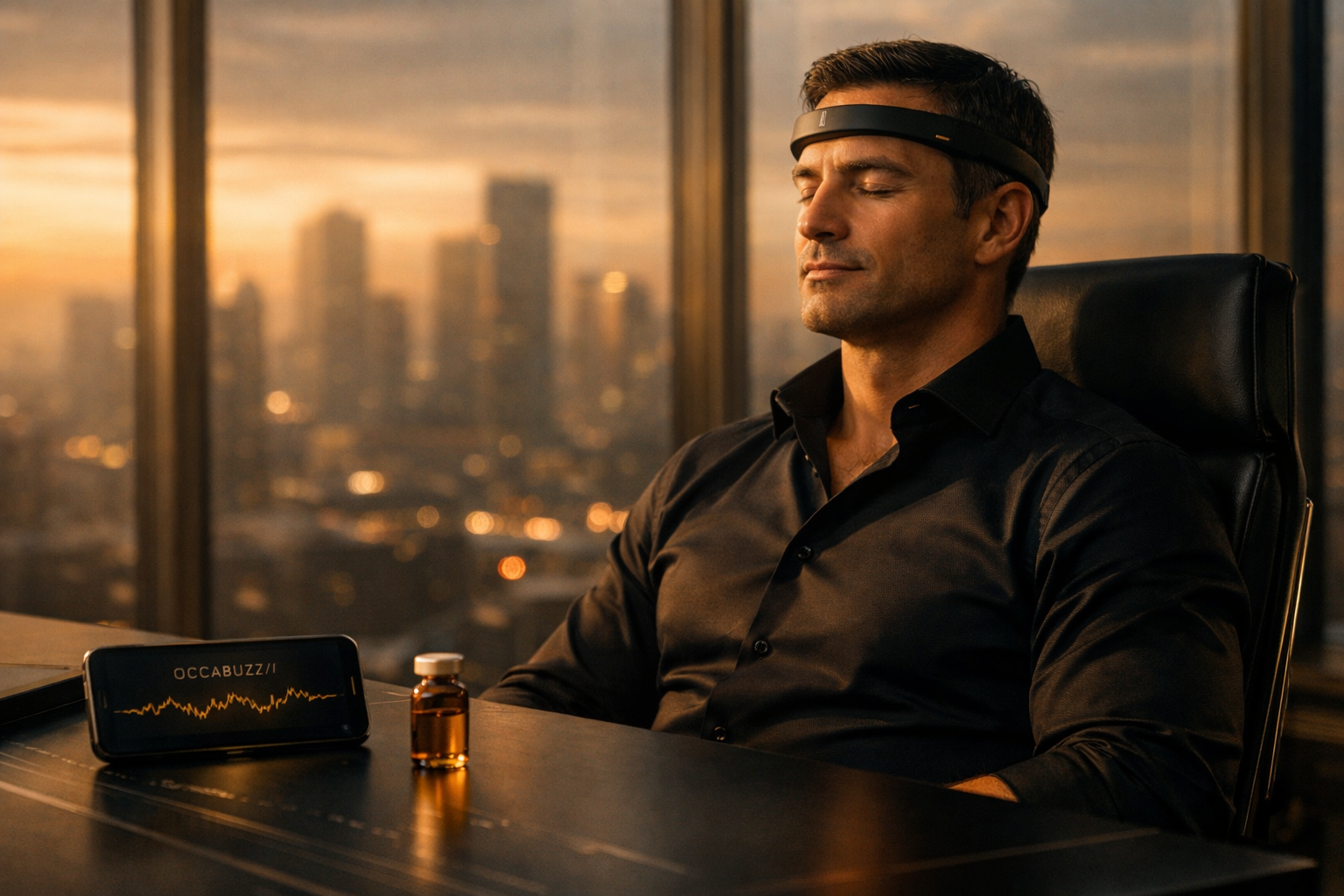
◇ THE OPERATOR — FOCUSED-ATTENTION TRAINING IN USE: THE BAND IS THE ONRAMP, THE REPS ARE THE TECHNOLOGY.
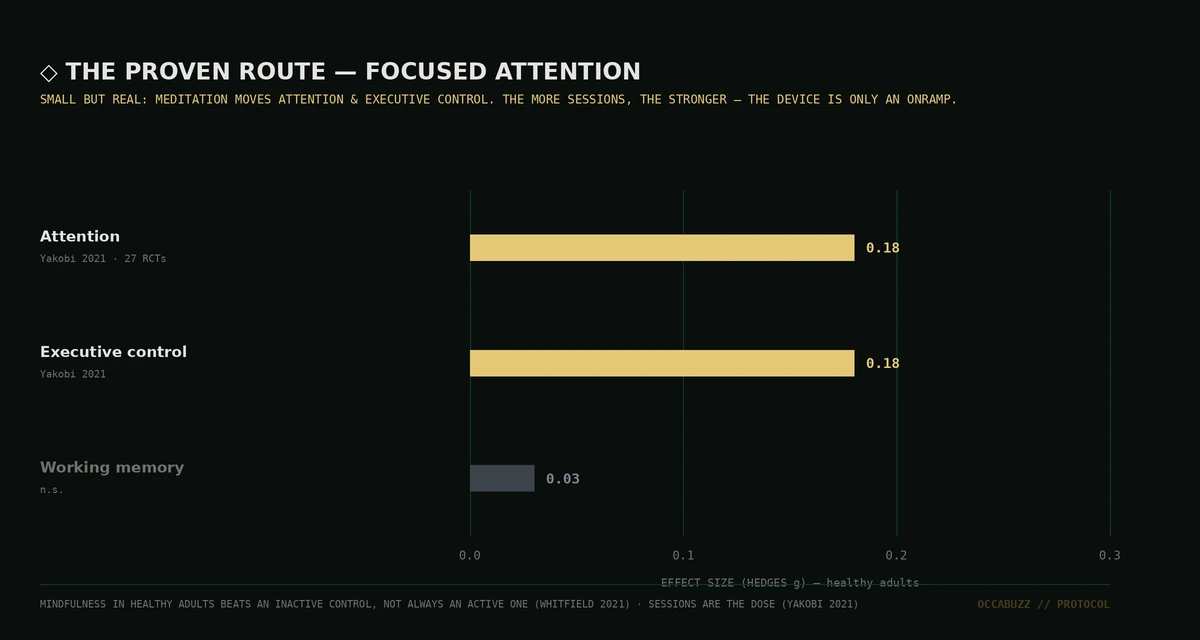
◇ THE PROVEN ROUTE — FOCUSED-ATTENTION MEDITATION MOVES ATTENTION & EXECUTIVE CONTROL (g≈0.18); SESSIONS ARE THE DOSE
◇ WHAT IT IS
Dossier 019 covered the consumer EEG headband — a real sensor whose measurable benefit is a small, possibly-placebo drop in distress, wrapped in a brain-training claim the controlled trials don't support. This protocol is the route the device only points at: focused-attention meditation, the practice that actually moves attention and executive control.
The premise is unglamorous and well-evidenced: attention is trainable, the training is simple, and the dose is repetition. You sit, you rest attention on one anchor (usually the breath), you notice when the mind wanders, and you return — again and again. That 'return' is the rep. Do enough of them and attention and executive control improve — small but real. A headband can make the first month more engaging; it cannot do the reps for you.
◇ THE COMPONENTS
The Anchor — one point of attentionRest attention on a single anchor (the breath at the nostrils or belly). The skill is not 'staying' — it is noticing the wander and returning. Each return is one repetition of the exact circuit you're training.
The Return — the actual repMind-wandering is not failure; catching it and returning IS the exercise. More returns, not fewer wanders, is the point — which is why beginners often improve fastest: they get the most reps.
Dose — sessions, not minutesThe meta-analytic signal scales with the number of sessions, not total hours. ~10–20 min on most days outperforms an occasional long sit (Yakobi et al. 2021). Consistency is the mechanism.
The Onramp (optional) — the EEG headbandFor the first 2–4 weeks, real-time feedback can make the practice engaging enough to stick and raises in-the-moment focus (Hunkin et al. 2020). Use it to build the habit, then take it off — the score is a mood ring, not the mechanism (see Dossier 019).
Expectations — small, real, cumulativeThis is not a nootropic. Effects on attention and executive control are modest (g≈0.18) and beat doing nothing more reliably than they beat an active alternative (Whitfield et al. 2021). The value compounds with consistency, not intensity.
◇ HOW TO DEPLOY — DAILY TIMING
Daily · 10–20 minFocused-attention meditation: anchor on the breath, notice wandering, return — the return is the repPractice
Every sessionCount returns, not perfection — a busy mind that keeps returning is training correctlyTechnique
Consistency > durationMost days beats occasional long sits; sessions are the dose (Yakobi 2021)Dose
Optional · first 2–4 weeksUse an EEG headband as an engagement onramp, then drop it — read the score as a mood ring, not a metricOnramp
OngoingExpect small, cumulative gains in attention and executive control — not a cognitive spikeExpectation
◇ WHAT CHANGES IN YOUR DAY
The win is a steadier attention span and a calmer baseline — built from the cheapest, most portable practice there is, needing nothing but a few minutes and a place to sit. For a stressed operator, the reduction in distress is the near-term payoff; the attention gains accrue quietly over weeks.
The long game is a trainable faculty most people never train. Attention is the substrate under every other kind of work, and it responds to practice the way muscle responds to load. Every session of noticing-and-returning is a rep in the one gym that improves how you think.
2035 HORIZONPROJECTION · NOT PROVEN FACT
The headband, graded honestly
As consumer BCIs get cheaper and add AI coaching, the brain-training claims will only get louder. When sham-controlled trials finally test whether the feedback adds anything beyond placebo, OCCABUZZ will grade the verdict against this free baseline — because a device that merely makes you meditate more is an onramp worth renting briefly, not a brain-upgrade worth wearing forever.
Closed-loop attention, matured
The real frontier is higher-fidelity, individually-calibrated neurofeedback that provably modulates a brain target under blinded conditions — not today's smoothed calm-score. If that arrives, it changes the grade. Until it does, the reps are the technology.
⧗ OPERATOR ADVISORY
Not medical advice. Focused-attention meditation is low-risk for most healthy adults; if you have a trauma history or a mental-health condition, some contemplative practices can be activating — proceed with a qualified teacher or clinician. A consumer EEG headband is a wellness gadget, not a medical or diagnostic device, and its scores are not a measure of your mental health. See Dossier 019.
◇ THE STANDARD // APPLIED TO THIS ASSET
◇ THE AUDIT — THIS ASSET, ON THE STANDARDCALIBRATED CERTAINTY = ∛(E · C · I)
Applies to healthy apex, not only to clinical deficit.
03 IMPLEMENTATION66
Survives a demanding calendar. Zero executive friction.
EMERGING
Signal is real but unproven. Watchlist, not protocol.
The sliders start at the OCCABUZZ assessment for this asset. Drag any layer to test the standard against our call.
The score is a geometric mean — a single failed layer collapses it. Excellence in two cannot rescue a gap in the third. That is why hype scores low and proven, feasible, broadly-applicable work scores high. The restraint is the product.