THE ATTENTION MIRROR // CONSUMER EEG NEUROFEEDBACK
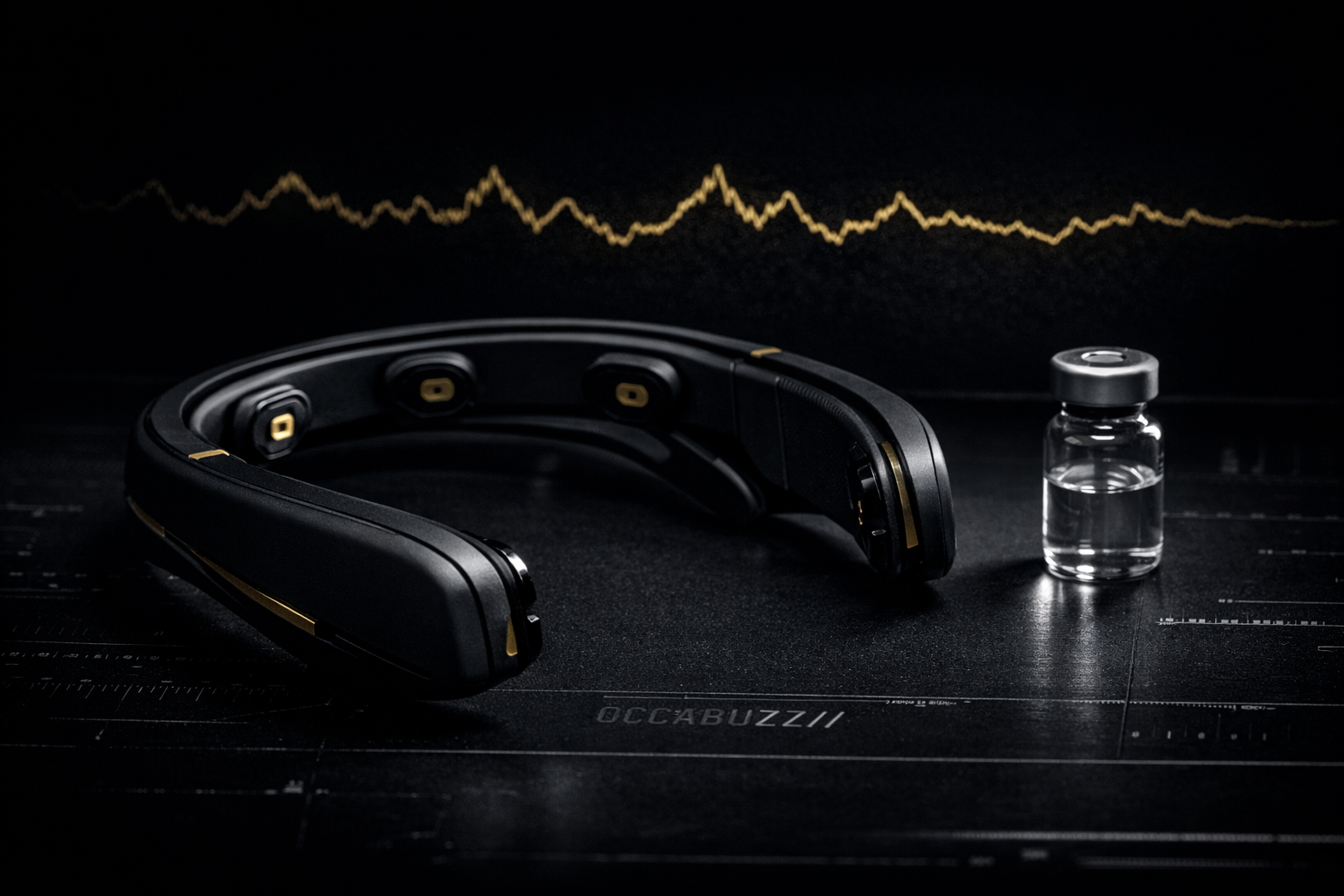
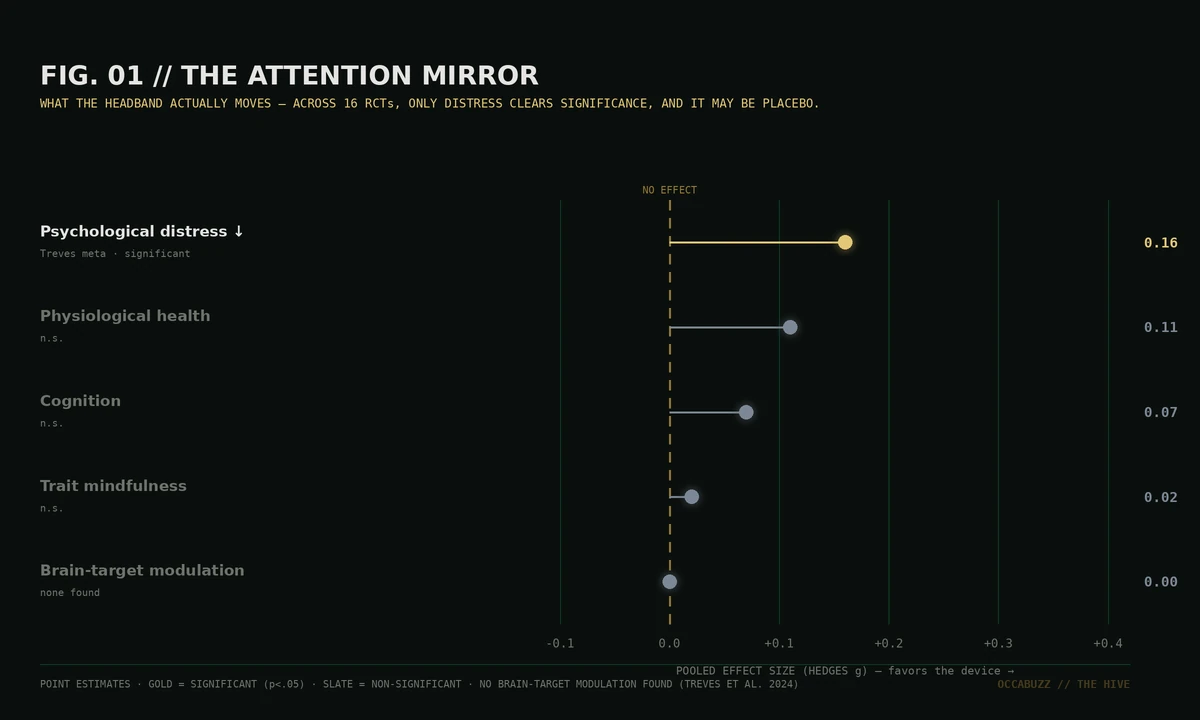
A consumer EEG headband is the most accessible edge of the brain-computer-interface frontier: a dry-electrode band that reads your brain's electrical rhythms and turns them into a calm-or-distracted score while you meditate. The sensor is real — it captures genuine EEG, especially the alpha rhythm of relaxed wakefulness (Lee et al., 2026). What it is sold as is a brain trainer, and that is where the honesty gap opens. Pooled across 16 randomized trials, consumer mindfulness-neurofeedback produced exactly one significant effect — a small reduction in psychological distress (g=−0.16) — with nothing on cognition, trait mindfulness, or physiological health, and no evidence that users actually modulated the brain targets the devices claim to train; the likely driver is 'neurosuggestion,' the placebo of neurotechnology (Treves et al., 2024). A real sensor, a small real benefit as a meditation onramp, and a brain-training promise the best-controlled trials do not support. This is the CGM story in a headband.
The consumer EEG headband is the most accessible edge of the brain-computer-interface frontier: a dry-electrode band that reads your brain's electrical rhythms and turns them into a calm-or-distracted score while you meditate. It is genuinely a sensor — it captures real EEG, especially the alpha rhythm of relaxed wakefulness. What it is sold as, though, is a brain trainer. Those are not the same claim, and the gap between them is this dossier.
Read against the best evidence, the honest picture is narrow. A 2024 meta-analysis pooled 16 randomized trials of consumer mindfulness-neurofeedback — most using the Muse device — and found exactly one significant effect: a small reduction in psychological distress (g=−0.16). Nothing on cognition, nothing on trait mindfulness, nothing on physiological health. And, decisively, no evidence that users actually modulated the brain targets the devices claim to train. The authors named the likeliest driver out loud — 'neurosuggestion,' the placebo of neurotechnology (Treves et al., JMIR 2024).
We grade it EMERGING, not rejected, because the device is real and the small in-the-moment benefit is real. But we refuse the brain-training frame. This is a mirror that reflects a rough version of your state and, for some people, makes meditation stickier — not a machine that upgrades your brain.
The Sensor — Real, But RoughTIER B (SIGNAL) / CONTEXT (FIDELITY)
A dry-electrode headband records real electroencephalography — the summed electrical rhythms of cortex — and consumer devices reliably pick up brain waves, particularly the alpha rhythm associated with relaxed wakefulness, when validated with structured protocols (Lee et al., Scientific Reports 2026). This is not a toy signal. It is a genuine, if narrow, window on cortical state.
But dry electrodes trade fidelity for convenience. Head-to-head against research-grade EEG, consumer bands show more low-frequency noise, and one comparison found the Muse device aligned poorly with a laboratory amplifier — the weakest of the devices tested (Mikhaylov et al., Sensors 2024). The 'calm score' on your phone is a smoothed, proprietary proxy derived from a noisier signal than a lab would accept. Read it as a mood ring with a real sensor behind it, not a clinical readout.
The Effect — Small, And Maybe PlaceboTIER B (ADJUNCT) / TIER C (ENHANCEMENT)
Used as a meditation adjunct, the device does something. In a controlled crossover, auditory EEG feedback during focused-attention meditation raised state mindfulness in the moment (RR 1.15) and lowered device-measured mind-wandering — a genuine, if modest, engagement aid (Hunkin et al., Mindfulness 2020). Pooled across trials, the one outcome that reached significance was a small drop in psychological distress (g=−0.16; Treves et al. 2024). For a stressed operator who will actually meditate more because a gadget makes it engaging, that is a real, if small, win.
Everything past that is unproven. The same meta-analysis found no effect on cognition, trait mindfulness, or physiological health, and — decisively — no evidence that users modulated the brain targets the devices claim to train; the authors flag placebo ('neurosuggestion') as the likely driver (Treves et al. 2024). A separate Muse trial found the device's own 'calm' scores did not track users' actual mindfulness or improvement at all (Acabchuk et al., Mindfulness 2020). And the field's hardest lesson: in neurofeedback for ADHD, effects that look real under unblinded ratings collapse under blinded, sham-controlled conditions (Cortese et al., JAACAP 2016). The brain-training claim is exactly the part that does not survive a placebo control.
Is a consumer EEG headband a brain trainer — or a real sensor wrapped around a placebo?
A dry-electrode band captures genuine EEG, including alpha rhythm, when validated properly. The hardware measures something real — just noisier and lower-fidelity than a laboratory.
Lee et al. — Evaluation framework for consumer-grade EEG devices (Scientific Reports, 2026) ↗As a meditation onramp it raises in-the-moment engagement, and pooled trials show a small drop in distress. A real, modest benefit for someone who will meditate more because of it.
Hunkin et al. — EEG neurofeedback during focused-attention meditation (Mindfulness, 2020) ↗No brain-target modulation found, no cognitive gain, scores that don't track mindfulness, and effects that vanish under sham control. The part sold hardest and supported least — likely placebo.
Treves et al. — Consumer-grade mindfulness neurofeedback: meta-analysis (JMIR, 2024) ↗The honest synthesis: the consumer EEG headband is a real sensor and a small, real meditation aid — and not, on current evidence, a device that trains or upgrades your brain. Its measurable benefit is a modest reduction in distress that may be largely the placebo of holding neurotechnology, and its own scores don't track the thing they claim to measure. For an operator, the calibrated deployment is the CGM's: use it for two-to-four weeks as an engagement onramp into the practice that actually carries the evidence — focused-attention meditation — then keep the practice and drop the band. A real sensor. An unearned promise.
The intervention with the evidence is not the headband — it is the practice it scaffolds. Focused-attention meditation produces small but real gains in attention and executive control in healthy adults, and the dose is sessions: the more you practice, the stronger the effect (Yakobi et al. 2021). It reliably beats doing nothing, though not always an active alternative (Whitfield et al. 2021). None of that requires a band on your head. Use the device, if you like, as a two-to-four-week onramp that makes the habit engaging — then let the habit carry itself. The band is a teacher for the first month, not the mechanism forever.
OCCABUZZ sells no device and earns no commission on any EEG headband — our revenue comes only from the operators we serve, never from what we grade, and it changes nothing here. We grade it EMERGING because the sensor and the small adjunct benefit are real, and we hold the brain-training and enhancement claims to 'unproven' precisely because that is the part the market inflates. The device is not a medical instrument and its scores are not a diagnosis. The evidence drives the grade. Nothing else does.
Peer-reviewed trials — sample size, effect size, stage.
Applies to healthy apex, not only to clinical deficit.
Survives a demanding calendar. Zero executive friction.
Signal is real but unproven. Watchlist, not protocol.
The score is a geometric mean — a single failed layer collapses it. Excellence in two cannot rescue a gap in the third. That is why hype scores low and proven, feasible, broadly-applicable work scores high. The restraint is the product.